How to Research Blog Topics (Without Guessing): A 2026 Step-by-Step Guide

TL;DR: 96.55% of all pages get zero traffic from Google (Ahrefs, 2023). The smartest way to research blog topics is to start with reader problems, confirm real search demand, then check whether you can actually rank — before you write a word. This six-step process replaces guesswork with evidence.
Disclosure: This post mentions tools I’ve used, some via affiliate links. I only recommend what I’ve tested. See my editorial approach for details.
Here’s an uncomfortable number to sit with: 96.55% of all pages get zero search traffic from Google, and another 1.94% get between one and ten monthly visits (Ahrefs, 2023). Most of those pages aren’t bad writing. They’re answers to questions nobody was asking.
That’s the real cost of guessing. You spend six hours on a post, hit publish, and it lands in the 96.55% — invisible. Do that for a year and you’ll wonder why your blog income timeline keeps slipping. The fix isn’t writing faster. It’s learning to research blog topics with data, so the work you do has a chance of being found.
This guide is the exact process I use to research blog topics before committing time to them. No procurement committee, no 40-tab spreadsheet — just six repeatable steps that separate topics with demand from topics that only feel important. Twenty years of testing what ranks (and what quietly dies) went into trimming it down to this.
Why Research Blog Topics So Carefully in 2026?
Because the open web is getting fewer clicks every year. In the first four months of 2026, 68.01% of Google searches ended without a click to any website (SparkToro, 2026). When you research blog topics today, you’re competing for a shrinking slice of attention — so picking the wrong topic costs more than it used to.
AI Overviews are a big part of that shift. On queries where Google shows an AI Overview, organic click-through rate fell to 0.61% in September 2025, down 61% from 1.76% a year earlier (Ahrefs, 2026). Some topics now get answered before anyone reaches your post. Knowing which ones is half the battle, and it ties directly into what changed after Google’s core update.
What You Need Before You Research Blog Topics
Before you research blog topics in earnest, spend ten minutes gathering a few essentials. Walking in without these is how people end up with a tidy list of ideas that have zero chance of ranking.
- A defined reader — who they are and the specific job they’re trying to get done (e.g., “new solo blogger trying to get a first 1,000 visitors”)
- Your site’s authority, honestly assessed — a six-month-old blog can’t fight the same keywords as Forbes
- One free keyword tool and one paid trial — I’ll cover specifics in Step 3
- A browser in incognito mode — so your search history doesn’t skew the live results you’ll inspect
- A simple shortlist doc — one row per candidate topic; you’ll score them at the end
- Time: ~45 minutes for a batch of 8–10 candidates
Step 1: Start With Reader Problems, Not Keywords
The first move when you research blog topics is to list your reader’s actual problems — not search terms yet, just plain-language frustrations. Topics that solve a real, felt problem are the ones people search for, share, and eventually buy from. Keyword tools come later; they’re useless if you point them at the wrong starting words.
Pull these problems from places where your audience already talks:
- Your own inbox and comments. The questions people ask you directly are pre-validated demand. Someone cared enough to type them.
- Reddit, niche forums, and Facebook groups. Read the questions that get dozens of replies. High engagement signals a topic people feel strongly about.
- Customer or reader surveys. One open-ended question — “What are you stuck on right now?” — surfaces language you’d never invent.
When I started writing down reader questions verbatim instead of brainstorming topics from my chair, my hit rate roughly doubled. The phrasing matters: real people don’t search “content ideation strategies,” they search “what should I blog about.” I lean on AI to cluster these raw notes into themes — close to the workflow I use Claude for — but the raw material always comes from real humans, never invented.
Step 2: How Do You Turn Problems Into Search Queries?
Once you have a problem list, the next way to research blog topics is to expand each one into the queries people actually type — and Google hands you these for free. The search box itself is the most underused research tool there is. Before you pay for anything, mine three free signals straight from the results page.
- Autocomplete. Start typing your problem and note every suggestion. These are real, popular queries ranked by Google.
- People Also Ask. Expand a few boxes; each one spawns more. This is a live map of related questions.
- Related searches. Scroll to the bottom of the results for eight more phrasings you hadn’t considered.
One caveat most guides skip: don’t treat People Also Ask as gospel. Only about 3% of searchers actually interact with a People Also Ask box (Backlinko, 2025). Use it to discover sub-questions worth a section in your post — not as proof that a standalone article will pull traffic. It’s an idea source, not a demand signal.
Step 3: Where Do You Find Real Search-Demand Data?

Now you research blog topics with hard numbers instead of vibes. This is where a keyword tool earns its keep: it tells you roughly how many people search a term each month and how hard the top results are to beat. But the numbers need context, because most keywords barely register — 94.74% of keywords get 10 monthly searches or fewer (Ahrefs, 2026).
That’s not a reason to chase only big numbers. Search demand is wildly concentrated: 91.8% of all queries are long-tail terms searched 100 times a month or less, and the median keyword sees just 10 searches a month (Backlinko, 2020). A pile of low-volume, low-competition topics often beats one impossible head term.
Here’s the part roundups won’t tell you: tools disagree, sometimes wildly. In my own checks, running the same seed term through two tools can return volume estimates that diverge two- to fivefold, because each models clickstream data differently. Treat any single number as a rough signal, not truth.
| Signal | What a free tool gives you | What a paid tool adds |
|---|---|---|
| Search volume | A rough range | Trend history + regional splits |
| Keyword difficulty | Often missing | A 0–100 score based on link data |
| Related terms | A handful | Hundreds, clustered by intent |
For solo budgets, start free (Google Keyword Planner, a trial of a paid suite) before committing. I compared the options in my guide to the best keyword research tools for solo bloggers, and for content-scoring specifically, see what the data shows about AI SEO tools. Both reinforce the same lesson: the tool matters less than how skeptically you read it.
Step 4: What About Search Intent and AI Overviews?

When you research blog topics in the AI-Overview era, demand alone isn’t enough — you need to know whether the click survives. Two checks take 60 seconds each and save you from writing into a wall.
First, confirm intent. Search your term and read the top results. If they’re all product pages and you planned a tutorial, the intent is commercial and your how-to won’t rank. Match the format Google already rewards for that query.
Second, check for an AI Overview. AI Overviews triggered for 15.69% of queries by November 2025 (Semrush, 2025), and they skew toward informational, long-tail questions — the median AI Overview keyword is four words long and 99.2% are informational (Ahrefs, 2024). If a simple definitional query already shows a complete AI answer, your post will fight for that 0.61% leftover click. Pick a topic with more depth than the overview can summarize.
Step 5: Can You Realistically Rank for It?
This is the step that makes the difference: research blog topics you can actually win, not just ones with demand. A topic owned by ten high-authority sites is a topic you’ll lose, and losing is expensive — only 0.44% of searchers ever click to page two of Google (Backlinko, 2025). Page two is the void.
Open the live results for your candidate and read them like a competitor:
- Who ranks? If page one is all major brands and government sites, move on. If you see forums, thin posts, or outdated pages, there’s an opening.
- Can you do better? Click the top three. If you can clearly write something more useful, current, or specific, that’s your wedge.
- Is the format winnable? A 6,000-word pillar at the top means you’d need to match it. A short, stale post means you can leapfrog it.
The honest assessment in point one is where most bloggers lie to themselves. I’ve talked myself into “I can outrank them” too many times. Now I need a concrete reason the incumbents are beatable before a topic makes my list.
What Search Volume and Difficulty Should a New Blog Target?
A new blog should target keywords with low difficulty (roughly under 20 on most 0–100 scales) and modest volume (about 50–500 monthly searches) for its first 20–30 posts. It’s the threshold to settle every time you research blog topics for a young site. The instinct to chase 10,000-volume terms is exactly backwards for a low-authority site — you can’t rank for them yet, so they earn zero.
Why these numbers work: low-difficulty terms are where a site with few backlinks can actually crack page one, and modest volume still adds up across many posts. Remember, most keywords are low-volume anyway, so a long-tail strategy isn’t settling — it’s matching how search demand is actually distributed. As your site earns authority, raise the ceiling. Tighten or loosen the thresholds based on your niche’s competitiveness, but start conservative.
Step 6: How Do You Prioritize Your Shortlist?
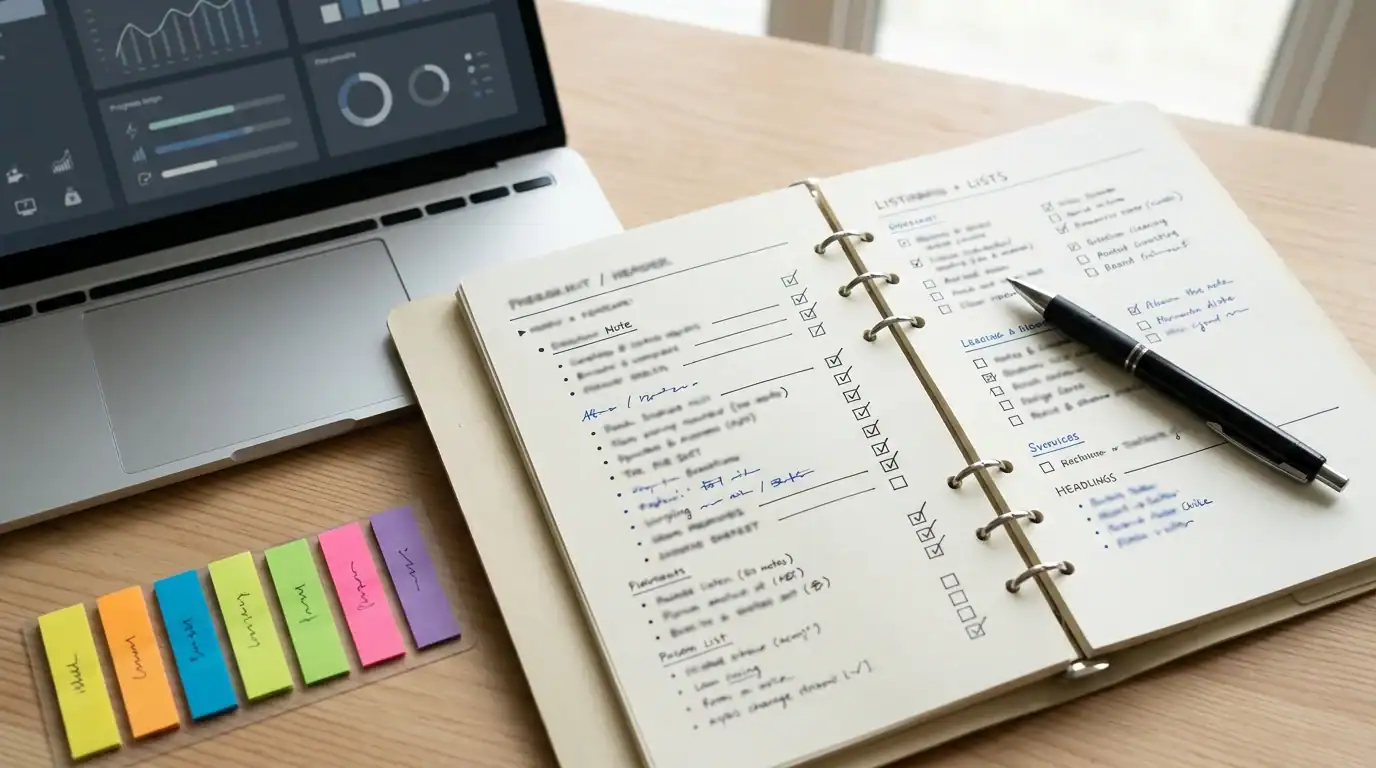
Finally, turn your candidates into a ranked queue — this is the repeatable system that lets you research blog topics in batches instead of agonizing one at a time. Score each candidate from 1 to 3 on four factors, then write the highest totals first.
- Demand: Is there confirmed search volume, even if modest?
- Winnability: Can your site realistically reach page one?
- Click survival: Will a click survive any AI Overview?
- Business fit: Does it connect to something you sell or recommend?
A topic scoring 10–12 is a clear yes. Anything under 7 goes to a “maybe later” list — revisit it when your authority grows. With a scored queue in hand, your next move is to write a blog post outline for the winners and group them into a coherent content strategy rather than publishing at random.
Common Mistakes When You Research Blog Topics
Most people who research blog topics fail in predictable ways. Avoid these four and you’re ahead of the field.
1. Chasing volume, ignoring difficulty. A 5,000-search term you can’t rank for is worth less than a 100-search term you can own. It’s the most common way to research blog topics badly — fixating on the big number and skipping the winnability check.
2. Trusting one tool’s numbers as fact. Volume estimates are models, not measurements, and they disagree. Cross-check two sources and treat the figure as a range.
3. Ignoring search intent. Writing a how-to for a query that wants a product list means you’ve lost before publishing. Always read the live results first.
4. Skipping the AI Overview check. This is the new one almost no guide mentions. If AI already answers the question completely, the click may never come — choose topics with more depth than a summary can capture.
Frequently Asked Questions
How do I research blog topics for free?
You can research blog topics for free using Google’s own signals: Autocomplete, People Also Ask, and related searches at the bottom of the results page. Add Google Keyword Planner for rough volume and Google Trends for seasonality. These cover demand and intent without a paid subscription — the paid tools mainly add speed and difficulty scores.
Should I research topics or keywords for my blog?
Both, in order: topics first, keywords second. Start with a reader problem (the topic), then use keyword data to confirm people actually search for it and to find the exact phrasing. Keyword-first thinking produces technically optimized posts nobody wanted; topic-first thinking with keyword validation is the balance that works.
What’s the best tool to research blog topics?
There’s no single best tool — it depends on budget. Google Keyword Planner and Google Trends are free and solid for starting out; Ahrefs and Semrush add difficulty scores and deeper data for a monthly fee. Because tools disagree on volume, the skill of reading them skeptically matters more than which one you pick.
How many blog topics should I research at once?
Research blog topics in batches of 8–10 candidates, then publish the top few. Batching is far more efficient than researching one topic per writing session, and a scored shortlist means you always know what to write next instead of staring at a blank page.
What search volume should a new blog target?
Aim for low-difficulty keywords (under ~20) with 50–500 monthly searches for your first couple dozen posts. Since 94.74% of keywords get 10 searches or fewer a month (Ahrefs, 2026), modest, winnable volume that compounds across many posts beats chasing head terms you can’t rank for.
How often should the topic-research process be repeated?
Run a full batch every 4–6 weeks, and keep a running notes file for ideas in between. Search demand shifts — 15% of daily Google searches have never been searched before (Ahrefs, 2026) — so periodic refreshes catch emerging topics your last batch couldn’t have surfaced.
The Bottom Line
When you research blog topics this way — problems first, demand confirmed, ranking checked, AI Overviews accounted for — you stop gambling six hours of writing on a hunch. The goal isn’t more posts; it’s posts that escape the 96.55% that get nothing. Pick one topic from your scored shortlist, outline it, and ship it this week. Then tell me in the comments which step changed your list the most.