How to Build a Blog That Ranks in 2026 (Complete Strategy)

TL;DR: To build a blog that ranks in 2026, you need a niche you have real experience in, topic clusters instead of random posts, content that proves you actually did the thing, and internal links treated as a system. Only 1.74% of new pages reach Google’s top 10 within a year (Ahrefs, 2025) — this guide is how you get into that 1.74%.
Disclosure: This post mentions tools I’ve used, some via affiliate links. I only recommend what I’ve tested. See my editorial approach for details.

Here’s the number nobody puts in their “start a blog” course: only 1.74% of newly published pages reach Google’s top 10 within a year, and the average #1 result is five years old (Ahrefs, 2025). If you want to build a blog that ranks, you’re not fighting for participation — you’re fighting for a seat at a very small table.
I’ve been building websites for twenty years, and in 2026 I got a masterclass I didn’t ask for: Google quietly deindexed most of this site’s legacy content after the December 2025 core update. I spent months diagnosing it, pruning dead posts, and rebuilding — and the index responded. This guide is that experience turned into a repeatable strategy: how to build a blog from niche selection through content clusters, on-page SEO, internal linking, and refreshing what you’ve published.
Nothing here is generic advice about how to build a blog recycled from other guides. It’s what worked — and what visibly failed — on my own site.
Why You Can’t Build a Blog the 2019 Way Anymore
The biggest change for anyone trying to build a blog in 2026 is that most searches no longer produce a click at all. In the first four months of 2026, 68.01% of US Google searches ended without a click to any website, up from 60.45% in 2024 — the fastest rise since tracking began (SparkToro/Similarweb data via Search Engine Land, 2026).
AI Overviews are doing a lot of that damage. When an AI Overview appears, the click-through rate for the #1 organic result drops by roughly 34.5% (Ahrefs, 2025), and Pew found users click a traditional result on only 8% of visits with an AI summary present, versus 15% without (Pew Research Center, 2025).
But here’s the flip side that makes it still worth it to build a blog: sources cited inside an AI Overview earn 35% more organic clicks than uncited ones (Seer Interactive, 2025). The 2026 game isn’t chasing raw traffic — it’s becoming the source that search engines and AI systems cite, then converting the smaller, higher-intent audience that does click. I covered the algorithm side of this in what changed after Google’s core update; this pillar is the full build-from-scratch strategy.
Step 1: Build a Blog Around Experience You Actually Have
The single most important decision when you build a blog is picking a niche where you can demonstrate first-hand experience — because that’s now literally what Google evaluates. Its own quality guidance asks whether content shows “first-hand expertise and a depth of knowledge (for example, expertise that comes from having actually used a product or service)” and states plainly that of E-E-A-T, “trust is most important” (Google Search Central).

A practical test I use: before you build a blog in a niche, list ten posts you could write that begin with “I tried,” “I measured,” or “I switched.” If you can’t, you’ll end up writing the generic explainer content the December 2025 core update was designed to filter out. That update rolled out December 11–29, 2025, with Google describing it as surfacing “relevant, satisfying content” — no tricks, no shortcuts (Search Engine Land, 2025).
Also sanity-check the money side early. Monetization follows trust, not the other way around — my blog monetization reality check covers realistic income timelines so you don’t quit at month four.
Step 2: How Do You Validate Demand Before Writing?
You build a blog that ranks by writing answers to questions people actually search — and 96.55% of all pages get zero traffic from Google, mostly because nobody validated demand first (Ahrefs, 2023). Ahrefs names three causes: no search demand, no backlinks, and mismatched search intent. All three are avoidable before you write.

My workflow is two posts long and I follow it for every article on this site: how to research blog topics without guessing walks the six-step demand-validation process, and the keyword research tools I actually use as a solo blogger covers the software. The short version:
- Start from reader problems, not keyword lists — then confirm search demand exists
- Check the SERP you’d enter — if every result is a DR80 brand, a new blog can’t win that fight yet
- Favor long-tail questions AI Overviews answer poorly: personal comparisons, tested numbers, local or niche specifics
- Score before you write — demand, difficulty, and whether you have experience to add
Position still pays: the #1 Google result takes 27.6% of clicks — ten times more than position 10 (Backlinko, 2025). Ranking #8 for a big keyword is worth less than ranking #1 for a small one.
Step 3: Why Do Topic Clusters Beat Random Posts?
A blog ranks as a body of work, not as individual posts — so plan clusters: one comprehensive pillar page linked to and from 5–10 focused supporting articles. This hub-and-spoke structure is how you build a blog with topical authority instead of a pile of orphaned pages, and it’s exactly how the post you’re reading fits this site’s own content marketing cluster.
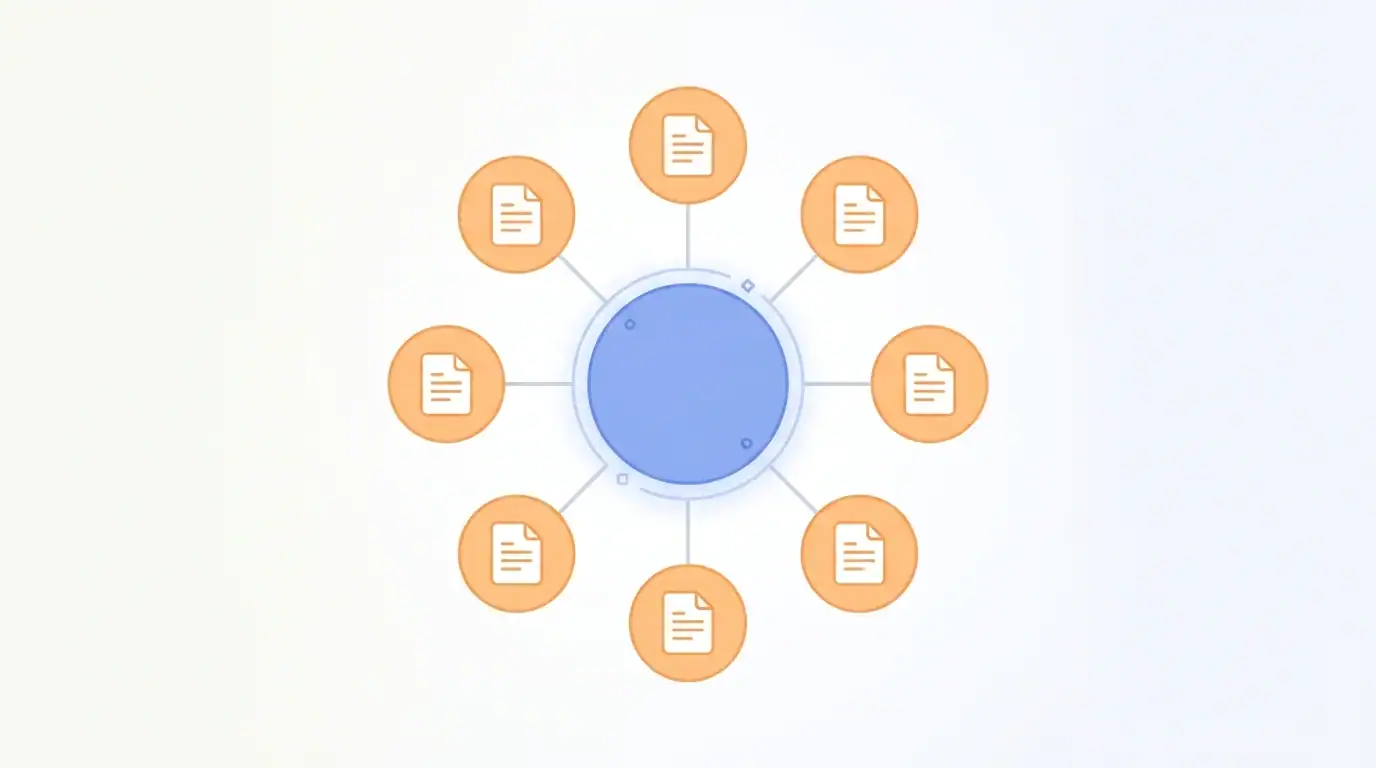
How I plan a cluster in practice:
- Pick one head topic you want to own (for me: content marketing for solo bloggers)
- Map 8–12 supporting questions from your keyword research — each becomes a spoke post with its own long-tail target
- Write spokes first, pillar last. I published four spokes over three months before writing this pillar, so every section here has something real to link to
- Outline each post before drafting — my blog post outline process keeps spokes from drifting into each other’s keywords
The common mistake is publishing whatever feels interesting that week. I have a graveyard of roughly seventy 2023-era posts on this site that prove the point: scattered topics, no cluster, no links between them — and Google eventually stopped indexing almost all of them. Depth beats breadth when you build a blog from zero.
Step 4: How Do You Set Up WordPress for SEO?
Platform choice is the easiest call you’ll make as you build a blog: WordPress powers 41.1% of all websites (W3Techs, 2026), and self-hosting it costs roughly $50–150 a year. What matters is configuring it so speed and crawlability are defaults, not projects. My setup stack, every piece of which I run on this site:
- Hosting: pick from my tested WordPress hosting shortlist — cheap hosting that adds 800ms of server response time is a tax on every post you’ll ever publish
- Theme: a lightweight theme; I benchmarked the big three in Kadence vs GeneratePress vs Astra on this very site
- SEO plugin: RankMath — here’s why I switched from Yoast
- Everything else: keep it minimal; my essential WordPress plugins list is deliberately short because every plugin is speed debt
On-page basics that should be muscle memory: one H1, descriptive H2s that don’t skip levels, a meta title under 60 characters, alt text on every image, and a clean URL slug without filler words. None of it is advanced. All of it is skipped constantly.
Step 5: Write Content That Proves You Did the Thing
The content that ranks in 2026 leads with evidence of experience — real numbers, real screenshots, real outcomes — and the survey data backs it: only 21% of bloggers report strong results overall, but among those publishing detailed 2,000+ word articles, that jumps to 39% (Orbit Media, 2025).
Here’s my own proof, from the wrong direction. Early this year I discovered Google had deindexed the bulk of this site’s 2023 content — generic, third-person explainer posts written for volume. When I pulled the Search Console data, mill-style posts on this site were indexing at just 16%. Every post written around something I’d personally tested was indexed and ranking. Same domain, same authority, same technical setup. The only variable was demonstrated experience.
You can’t build a blog that ranks on content anyone could have written without doing the work. That’s why every article I publish now contains real tested numbers, including this one.
Practical rules I now write by:
- Open every section with the answer in the first one or two sentences — that’s what both featured snippets and AI Overviews extract
- Include at least two first-person tested passages per post — what you ran, what happened, with numbers
- Use AI as a drafting tool, not a ghostwriter. 95% of content marketers now use AI (Orbit, 2025) — the differentiator is the experience layer AI can’t fake, and Google’s update targets exactly the posts missing it
- Cite real sources inline — named source, year, working link. Unsourced stats are trust debt
Step 6: How Should You Build Internal Links?
Internal linking is the highest-leverage SEO work you control completely: pages with 40–44 internal links pointing at them earn roughly four times the Google clicks of pages with 0–4, and pages with at least one exact-match anchor had over five times more traffic (Zyppy study of 23 million internal links, 2026).
I tested this on my own recovery. During July’s cleanup I found four published posts with zero inbound internal links — orphans Google was barely crawling. One editing sweep added seven contextual internal links pointing at those four stranded posts, and within weeks every one of them was back in the crawl queue. Total cost: one afternoon.
The system, if you’re starting to build a blog today:
- Every new post links to 3–6 related posts with descriptive, keyword-relevant anchor text — never “click here”
- Every new post receives links from at least 2–3 older posts within a week of publishing — new content with no inbound links is invisible
- Pillars link every spoke; every spoke links the pillar — the hub-and-spoke shape from Step 3, made literal
- Audit quarterly for orphans — a post nothing links to is a post you’re asking Google to ignore
Step 7: Measure, Refresh, and Prune Without Mercy
Publishing is only the halfway point when you build a blog: bloggers who update old articles are twice as likely to report strong results (Orbit Media), and 72.9% of pages in Google’s top 10 are more than three years old (Ahrefs, 2025). Old posts aren’t a liability — unmaintained posts are.

My quarterly routine, built during this year’s recovery:
- Pull Search Console’s indexing report. Sort posts into indexed, crawled-but-not-indexed, and discovered-but-not-indexed — each bucket gets a different treatment
- Refresh what’s close. Posts ranking 5–15 get updated stats, new experience passages, and better internal links. Update the modified date only when you substantively changed the content — Google noticed when I had bulk date-stamping on old posts, and it hurt, not helped
- Prune what’s dead. I triaged my ~70 dormant 2023 posts this July: redirect the few with backlinks, delete the rest. A hundred zombie pages drag down how Google scores everything else you publish
- Double down on winners. A post that ranks is telling you where your authority already is — build the next spokes there
The Honest Timeline: How Long Until You Rank?
When you build a blog from scratch, expect six to twelve months of consistent work before meaningful organic traffic — that’s what the data supports, not what course sellers promise. Only 1.74% of new pages crack the top 10 within a year, down from 5.7% in 2017 (Ahrefs, 2025). Interestingly, of the pages that do break through, 40.82% did it within a month — almost always pages on established sites with existing authority, which is what Steps 3 and 6 are quietly building you.
What to do while you wait: keep publishing spokes on schedule, keep adding internal links, and start collecting the experience material (tests, numbers, screenshots) that will feed future posts. The average post now takes 3 hours and 25 minutes to produce (Orbit, 2025). Budget for that honestly — a sustainable pace you can hold for a year beats a sprint that dies at month three.
Advanced: Ranking When the Answer Engine Is the Audience
Once the fundamentals above are in place, the 2026 frontier for anyone who wants to build a blog with staying power is optimizing to be cited, not just ranked. Being named as a source inside an AI Overview earns 35% more organic clicks than not being cited (Seer Interactive, 2025) — and the traits that get you cited are measurable: answer-first paragraphs under 60 words, unique first-party data, clear entity naming, and question-formatted headings.
The practical move: give every section a citable capsule — one tight, self-contained paragraph an AI system can lift with your name attached. Original numbers are citation magnets; a stat that exists only on your blog forces attribution. This is the deep end, and it assumes the basics are done — a site with thin content and no cluster structure has nothing worth citing yet. My core update breakdown goes deeper on the mechanics.
Tools I Actually Use to Build a Blog
If you only get two: a keyword research tool and RankMath. The full stack behind this site:
- Keyword research: my tested picks in keyword research tools for solo bloggers — free tier first, upgrade when a workflow proves itself
- WordPress hosting: the seven hosts I shortlisted after testing — best for anyone starting from zero
- Theme: winner and runners-up in my theme benchmark — best for speed without a page builder
- SEO plugin: RankMath (free tier is enough to start) — best for structured data and on-page checks
- Plugins: the short essential plugins list — best default for a new build
Getting Started This Week
Your first action takes five minutes: write down the one topic where you have experience nobody would have to take on faith. That’s the seed you build a blog around.
Then, this week: validate ten post ideas against real search demand using the topic research process, and sketch one cluster — a pillar plus eight spokes. Next week: set up WordPress with a fast host and theme from the lists above, and publish spoke #1 with two tested passages and three internal links.
The hesitation I hear most is “the niche is too competitive.” The data says otherwise: the winners aren’t outspending you, they’re out-structuring you — and structure is free.
FAQ: Building a Blog That Ranks
How long does it take for a new blog to rank on Google?
Most new pages take months to a year: only 1.74% of newly published pages reach Google’s top 10 within a year, and the average #1 result is five years old (Ahrefs, 2025). When you build a blog, plan for 6–12 months of consistent publishing and internal linking before meaningful organic traffic arrives.
Is it still worth it to build a blog in 2026?
Yes — if you play the current game. 68% of US Google searches end without a click (SparkToro, 2026), but bloggers publishing detailed 2,000+ word content report strong results at 39% versus the 21% average (Orbit Media, 2025). The clicks concentrate on fewer, better sites.
How many posts do I need before I see traffic?
There’s no magic number — structure beats volume. Since 96.55% of pages get zero Google traffic (Ahrefs), 20–30 posts forming one tight topic cluster outperform 100 scattered ones. Write spokes around one head topic and connect them before starting a second cluster.
Does AI-written content rank on Google?
Google filters low-value content, not AI use itself — 95% of content marketers now use AI (Orbit Media, 2025). What the December 2025 core update rewards is demonstrated first-hand experience layered on top. Use AI to build a blog faster, not to fake experience — pure AI output with no tested detail is exactly what gets filtered.
How much does it cost to build a blog?
Roughly $50–150 per year for a domain plus self-hosted WordPress — the platform behind 41.1% of all websites (W3Techs, 2026). The real cost is time: the average post takes 3 hours 25 minutes to produce (Orbit Media, 2025), so budget hours, not just dollars.
What is E-E-A-T and does it really affect rankings?
E-E-A-T is Google’s framework of Experience, Expertise, Authoritativeness, and Trust — and Google says “trust is most important.” Its guidance explicitly asks whether content demonstrates first-hand expertise “from having actually used a product or service.” On my own site, experience-rich posts stayed indexed through 2026’s updates while generic explainers were dropped.
Should I update old posts or write new ones?
Both, but never skip updates: bloggers who refresh old articles are twice as likely to report strong results (Orbit Media), and 72.9% of Google’s top-10 pages are over three years old (Ahrefs, 2025). Age plus genuine freshness is the winning combination — just never fake the modified date.
The Strategy in One Sentence
Build a blog around experience only you have, structure it as clusters, link it like a system, and maintain it like an asset — that’s the entire strategy, and every step compounds the others. The open web is consolidating around fewer, more trusted sources; the December 2025 update made that explicit. Your job is to be one of them in one niche. Start with the five-minute niche exercise above, and come back to this page as you hit each step.
Continue Learning
Research & planning:
- How to Research Blog Topics (Without Guessing): A 2026 Guide
- The Best Keyword Research Tools for Solo Bloggers
- How to Write a Blog Post Outline
SEO & strategy:
WordPress setup:
- 7 Best WordPress Hosting Options for Small Business
- Kadence vs GeneratePress vs Astra: I Ran All Three
- Essential WordPress Plugins: What You Actually Need
About the author: Noel Cabral has built and run websites for twenty years, from military service to full-time online business. He publishes tested strategies at noelcabral.com to help solo creators build a blog that actually ranks — including the 2026 deindexing recovery documented on this site. More about Noel or get in touch.